

7 Signs Your Self-Care Routine Is Not Working
You carved out the time. You bought the bath salts, lit the candle, poured the tea. And yet you still crawled into bed feeling just as wired, just as depleted, just as unable to switch off as you did before any of it. If that sounds familiar, your self-care routine may not actually be doing what you think it is. The problem is rarely a lack of effort. More often, the rituals look right on the surface but are structured in ways that keep your nervous system stuck in the same stressed-out loop they were supposed to interrupt.
Table of Contents
- Quick Takeaways
- Sign 1: You Treat Self-Care as a Task to Complete
- Sign 2: Your Routine Starts Too Late in the Evening
- Sign 3: You Are Scrolling While Soaking
- Sign 4: Your Products Are Working Against Your Body
- Sign 5: You Are Still Mentally at Work
- Sign 6: Your Routine Is Inconsistent but You Blame the Ritual
- Sign 7: You Feel Guilty the Whole Time
- Comparing Approaches That Actually Help You Decompress
- Frequently Asked Questions
- References
Quick Takeaways
| Key Insight | Explanation |
|---|---|
| Self-care must feel restorative, not obligatory | If your evening routine feels like another item on a checklist, your brain will treat it as work, not recovery. The activity needs to genuinely refuel you. |
| Timing determines effectiveness | Starting a wind-down ritual within 30 minutes of bedtime gives your body almost no buffer. Begin decompressing at least 60 to 90 minutes before you want to sleep. |
| Phone use cancels out bath benefits | Scrolling social media or reading emails while in the bath keeps cortisol elevated. Sensory inputs from screens compete directly with the relaxation signal you are trying to send. |
| The wrong product can reverse progress | Energizing citrus or peppermint scents, or products with stimulating caffeine, actively work against evening decompression. Lavender, chamomile, and magnesium-based products are better choices for nighttime use. |
| Mental replay prevents physical relaxation | If you are mentally rehearsing tomorrow's meeting while soaking in a bath, your body cannot fully shift into a parasympathetic state. A short journaling or brain-dump session before your ritual can help. |
| Consistency outperforms intensity | A five-minute consistent ritual done nightly signals safety to your nervous system far more effectively than an elaborate two-hour routine done once a week. |
| Guilt erases the physiological benefit | Feeling that you do not deserve rest, or that you should be doing something productive, triggers a low-grade stress response that directly counteracts the calm you are trying to build. |
Sign 1: You Treat Self-Care as a Task to Complete
The clearest sign that your routine is not helping you decompress after work is when it sits on your to-do list between "reply to emails" and "prep coffee for tomorrow." When self-care becomes a box to tick, your brain encodes it as a demand, not a refuge. The stress response does not care that the demand involves a bath bomb.
Mental health professionals consistently make this point: self-care should refuel you, not feel like something you force yourself to do. If you regularly feel a sense of relief when you "finish" your self-care, that is a strong signal the ritual has become performative rather than restorative.
The fix is less about adding new steps and more about subtracting pressure. Choose one or two things you genuinely look forward to. At Bathwater and Beyond, the whole premise of curated monthly drops is built on this idea: a smaller selection of things you actually want to use is more restorative than an overwhelming shelf of products you feel obligated to work through.
Pro tip: Before starting your evening routine, ask yourself: "Am I doing this because I want to, or because I feel like I should?" Answering honestly takes less than five seconds and will tell you everything about whether the next 30 minutes will actually help you relax.

Sign 2: Your Routine Starts Too Late in the Evening
A self-care ritual that begins at 11 PM when you plan to be asleep by 11:30 is not a wind-down. It is a rushed performance with no physiological payoff. Your body needs a genuine buffer between stimulation and sleep, and that buffer cannot be compressed into a few minutes without losing most of its effect.
Why timing matters more than the activity itself
The body's shift toward rest is a gradual process. Warm baths, for example, help lower core body temperature as you exit the water, a drop that supports the onset of sleep. But that process takes time. Starting your bath 20 minutes before you need to be asleep skips the transition your nervous system is trying to make.
A practical target for most people is to begin actual decompression activities at least 60 to 90 minutes before the time you want to fall asleep. That does not mean you need an elaborate routine. It means you need enough runway. Even 15 minutes of a genuinely calming activity, started early enough, will outperform an hour of rushed rituals started too late.
Pro tip: Set a "start winding down" alarm rather than just a bedtime alarm. The earlier cue is the one that actually changes your evening.
How to restructure your evening routine tips for better timing
Move your most calming activities earlier, not later. If a bath is the anchor of your routine, consider bathing at 8:30 PM instead of 10:45 PM. Use the time after the bath for lighter, lower-stimulation activities like reading or gentle stretching. This sequencing works with your body's natural rhythm rather than against it.
Sign 3: You Are Scrolling While Soaking
This is the most common and most quietly damaging habit in an otherwise thoughtful self-care routine. You have drawn the bath, you are using a beautiful product, and your phone is propped up on the edge of the tub. From a nervous-system standpoint, you are not actually in the bath. You are still in the digital stream.
Screens deliver continuous novelty, which is exactly what the brain's alert system feeds on. Every notification, every post, every comment thread keeps a small part of your stress response engaged. The warm water cannot override that signal when the signal is still being actively refreshed every few seconds.
The point of an evening ritual is to give your nervous system a clear, unambiguous signal that the demands of the day are over. Anything that introduces new information, new decisions, or new social comparison during that ritual is working against that signal.
Leaving your phone in another room, or at minimum setting it to do-not-disturb face-down on a surface you cannot see from the bath, is one of the highest-return changes you can make to your wellness habits without buying a single new product.
Sign 4: Your Products Are Working Against Your Body
Not all self-care products are designed for evening use, and using the wrong ones at night can actively impede relaxation. This is a problem that rarely gets named because the products look the part. They are in nice packaging, they smell pleasant, and they feel indulgent. But the scent or active ingredient profile can be stimulating rather than calming.
Scents that energize versus scents that calm
Peppermint, eucalyptus, and citrus scents (lemon, grapefruit, orange) are associated with alertness and mental clarity. These are excellent choices for a morning shower or a midday refresh. Used in an evening bath, they can signal wakefulness to your brain at exactly the moment you are trying to wind down.
For evening decompression, look for lavender, chamomile, sandalwood, and vanilla-based products. Magnesium flakes or Epsom salts in a bath can also support muscle relaxation in a way that has a genuinely calming physical effect.
The candle problem
The same logic applies to candles. A bright, sharp citrus candle in your evening wind-down space is a small but real contradiction. If you are building an environment designed to tell your nervous system the workday is over, every sensory cue in that environment should reinforce the same message. At Bathwater and Beyond, the curated candle selection is built with this in mind: scent profiles matter, and an evening candle should earn its place in the ritual by actually supporting rest.

Sign 5: You Are Still Mentally at Work
Your body can be in a bath full of calming products while your mind is in a meeting that ended four hours ago. Mental preoccupation is one of the most effective ways to cancel out the physical benefits of any self-care ritual. If you regularly find yourself planning tomorrow, replaying a difficult conversation, or troubleshooting a problem while you are supposedly relaxing, the ritual has become a backdrop rather than the main event.
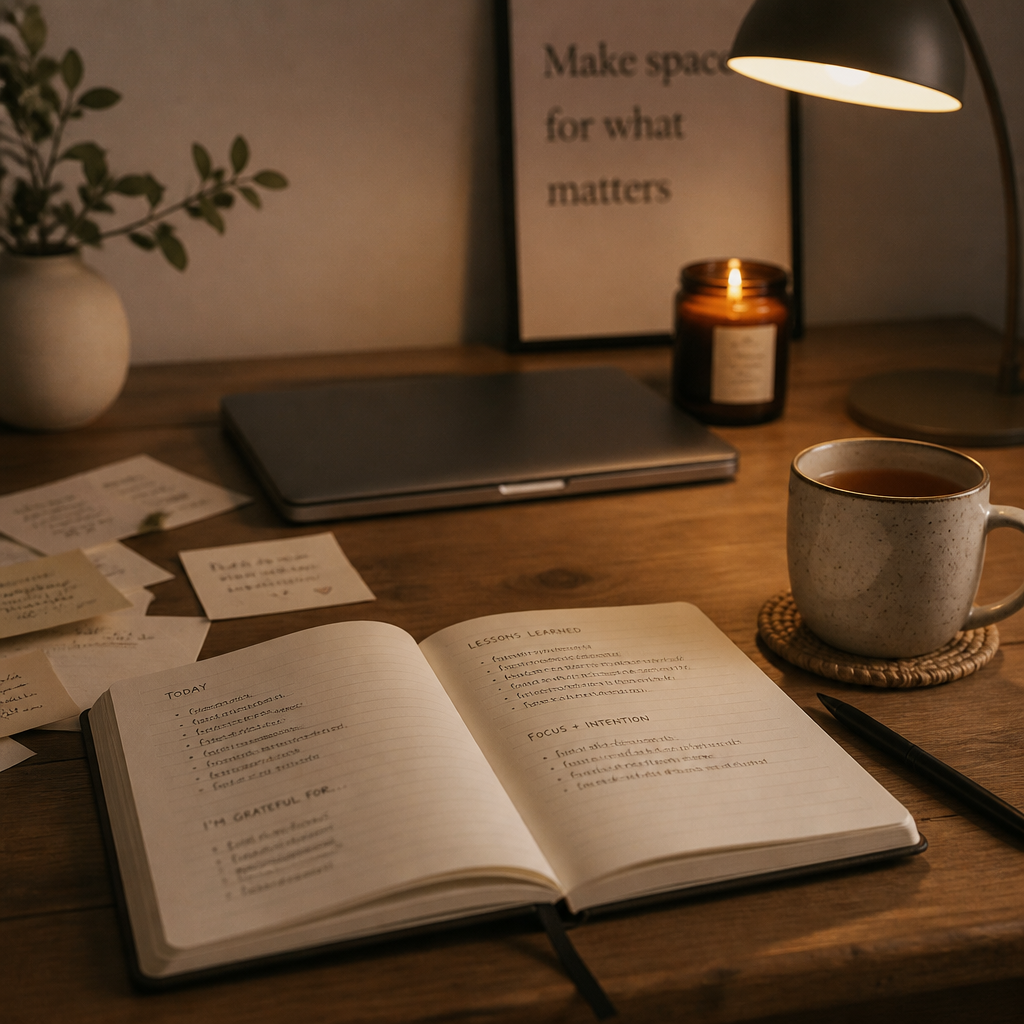
A common and effective solution is a short "brain dump" or journaling session before you begin any physical self-care. The goal is to externalize the mental noise by writing it down so your brain stops cycling through it. Five minutes of unstructured writing, listing every outstanding thought, task, or worry, can create enough mental space for a bath or a quiet sit to actually register as rest.
This is one area where the research on journaling and stress reduction is consistent: writing thoughts down reduces the cognitive load of holding them in working memory. You are not solving problems in the journal. You are parking them so your nervous system can take a break.
Sign 6: Your Routine Is Inconsistent but You Blame the Ritual
A self-care routine that happens twice a month is not a routine. It is an occasional treat. There is nothing wrong with an occasional treat, but you cannot expect it to produce the cumulative, nervous-system-level decompression that a consistent evening practice builds over time.
The body responds to repeated cues. When you do a specific sequence of calming activities at roughly the same time each evening, your brain begins to anticipate the shift. The ritual itself starts to trigger relaxation before you have even finished it, because your nervous system recognizes the pattern. That anticipatory calm is only available to you if the pattern is consistent enough to be recognized.
A five-minute routine done every evening will, over weeks, deliver more genuine decompression than an elaborate two-hour ritual done sporadically. Start smaller than you think you need to. The consistency is the point.
If you notice yourself abandoning your routine whenever life gets busy, that is also important information. The routines that survive stress are the ones designed for your actual life, not for an idealized version of it. Build something realistic enough to maintain on a difficult Tuesday, and it will be there for you on the easy ones too.
Sign 7: You Feel Guilty the Whole Time
This one is uncomfortable to name but extremely common. You are in the bath, the candle is lit, everything looks like self-care from the outside, and there is a low hum of guilt running the whole time. You feel like you should be answering messages. You feel like relaxing is something you need to earn. You feel vaguely selfish for taking the time.
That guilt is a stress response. It is physiologically incompatible with the parasympathetic state you are trying to reach. You cannot simultaneously feel guilty about resting and get the benefits of rest. The two states are in direct competition.
Reframing this is not a matter of positive thinking. It is about recognizing that decompression is not a reward for finishing everything. It is a necessary part of being functional. As Mental Health First Aid's guidance on self-care notes, self-care practices are meant to reduce stress and maintain wellbeing so you can show up effectively, for yourself and for others. Rest is part of the system, not a break from it.
If guilt is a persistent feature of your evenings, it may be worth examining where that belief came from and whether it is actually serving you, or simply costing you the sleep and recovery you need to do the things you care about.
Comparing Approaches That Actually Help You Decompress
Not all decompression strategies deliver the same results. Here is a direct comparison of three common evening approaches, looked at honestly rather than charitably.
| Approach | What It Does Well | Where It Fails |
|---|---|---|
| Passive screen time (TV, scrolling) | Requires no effort, feels like a break from active work | Keeps the nervous system in a reactive state; blue light interferes with melatonin onset; novelty feed maintains low-grade alertness |
| Elaborate multi-step beauty routine | Creates a sensory ritual; can feel intentional and grounding | Can become task-oriented and stressful if treated as performance; product choice matters and stimulating formulas undercut the benefit |
| Simple, consistent bath ritual with intentional product choice | Temperature shift supports sleep onset; calming scent profiles reinforce the signal; low decision load makes consistency easier | Loses effectiveness if phone is present, timing is too late, or guilt and mental preoccupation are not addressed first |
The pattern here is clear. The most effective approach is not the most elaborate one. It is the one that sends a consistent, unambiguous signal to your body that the day is over, with as few contradictions built into it as possible.
Frequently Asked Questions
How long does a self-care routine need to be to actually help you decompress?
Length is far less important than consistency and intention. A focused 15-minute routine done nightly, with no phone and a genuinely calming activity, will produce more decompression over time than a 90-minute routine done twice a month. Start with what you can actually sustain before adding more.
What is the difference between self-care that relaxes you and self-care that just distracts you?
Relaxation involves a physiological shift toward a calmer state: slower breathing, reduced muscle tension, lower mental load. Distraction occupies your attention without producing that shift. Scrolling social media is distraction. Sitting in a warm bath with a calming scent and no screen input is closer to actual relaxation. The test is how you feel 20 minutes after finishing. Relaxed means you feel quieter. Distracted means the noise floods back immediately.
Can evening routine tips work for people who do not get home until late?
Yes, but the approach needs to be realistic. If you are home at 10 PM and need to sleep by 11 PM, a 90-minute wind-down is not available to you on weeknights. In that case, focus on one high-impact change, such as putting your phone down 30 minutes before bed and replacing screen time with something sensory and calm. A short bath or even a 10-minute soak with the right products can do meaningful work in a compressed window if everything else is supporting it.
Are wellness habits like journaling actually useful for decompression, or is it overhyped?
Journaling is genuinely useful for one specific purpose: offloading the mental loop of unresolved thoughts that keeps your brain in problem-solving mode. It is not magic, and it does not work equally for everyone, but the core mechanism is sound. Writing down what is cycling through your head reduces the cognitive effort of holding it in memory, which frees up mental space for actual rest. Five minutes of unstructured writing before a bath or bed is enough to test whether it helps you.
What self-care products should I avoid using in an evening routine?
Avoid products with energizing essential oils like peppermint, eucalyptus, rosemary, and citrus in the evening. Also be cautious with any products marketed as "energizing," "awakening," or "revitalizing," these descriptors usually signal a stimulating formula. For evening use, prioritize lavender, chamomile, sandalwood, and magnesium-rich bath soaks. The same applies to candles: the scent in the room is part of the environment you are creating, so it should match the state you are trying to reach.
Is it normal for a self-care routine to take weeks before it starts working?
Yes, and expecting immediate results is one of the reasons people abandon routines too soon. The body learns through repetition. A new evening ritual is teaching your nervous system a new pattern, and that takes time to register. Most people start to notice a genuine difference after two to three weeks of consistent practice. The key word is consistent. Doing something nightly for 14 days is more effective than doing it intensely for a weekend and then sporadically after that.
What does your evening routine actually look like right now, and which of these signs feels most familiar to you? Share your experience in the comments.