

Bath Before Bed Sleep: The Science Behind It
Most people who struggle to fall asleep are not missing a prescription. They are missing a body temperature drop. A bath before bed sleep protocol works because of a specific physiological mechanism, not because of aromatherapy vibes or placebo effects. A 2019 meta-analysis published in Sleep Medicine Reviews analyzed 17 studies and found that soaking in warm water between 40 and 42.5 degrees Celsius, roughly 60 to 90 minutes before bed, reduced the time it takes to fall asleep by an average of 10 minutes. That is a clinically meaningful result. Here is exactly why it happens, and how to build it into an evening routine that actually sticks.
Table of Contents
- Quick Takeaways
- The Core Mechanism: Thermoregulation and Sleep Onset
- The Optimal Bath Window: Timing Is Everything
- Warm Bath Benefits Beyond Sleep
- How Temperature Choices Compare
- Building Your Evening Ritual Around the Bath
- Common Mistakes That Undercut the Science
- Frequently Asked Questions
- References
Quick Takeaways
| Key Insight | Explanation |
|---|---|
| The mechanism is thermoregulation, not relaxation | A warm bath draws heat to your skin's surface. When you exit, core body temperature drops rapidly, signaling the brain to release melatonin and initiate sleep onset. |
| Timing window is 60 to 90 minutes before bed | This gives your body time to complete the cooling cycle. Bathing too close to bedtime can temporarily raise core temperature and delay sleep instead. |
| Optimal water temperature is 40 to 42.5 degrees Celsius | Cooler showers do not produce the same vascular response. Hotter water risks skin irritation and overstimulation without added sleep benefit. |
| Even a 10-minute soak produces measurable results | The 2019 Sleep Medicine Reviews meta-analysis found a 10-minute average reduction in sleep onset latency across 17 studies, even with shorter soak durations. |
| Magnesium absorption from bath salts is a real bonus | Transdermal magnesium uptake through the skin during soaking supports the nervous system's ability to wind down, complementing the thermal effect. |
| Scent layering with lavender extends the benefit | Research from the National Institutes of Health shows lavender essential oil inhalation lowers heart rate and skin conductance, measurable markers of relaxation. |
| Consistency matters more than perfection | A nightly bath routine trains your circadian rhythm over time. The signal becomes stronger the more regularly it is repeated, similar to other sleep hygiene anchors. |
The Core Mechanism: Thermoregulation and Sleep Onset
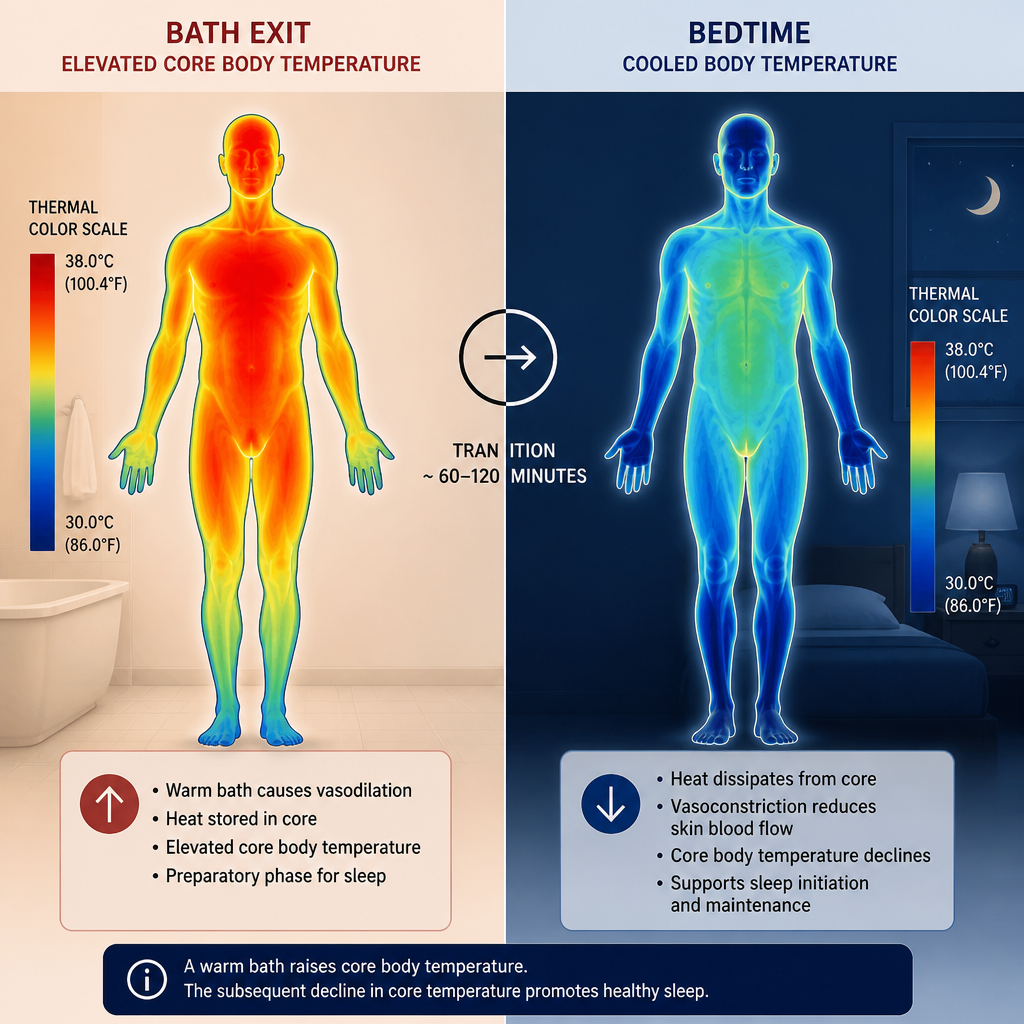
Your body follows a predictable thermal schedule every night. Core body temperature begins to fall approximately two hours before your natural sleep time, and it continues dropping through the night, reaching its lowest point around 4 a.m. This drop is not a side effect of sleep. It is a trigger for it. The hypothalamus, which governs your circadian rhythm, uses falling core temperature as one of its primary cues to begin the sleep process.
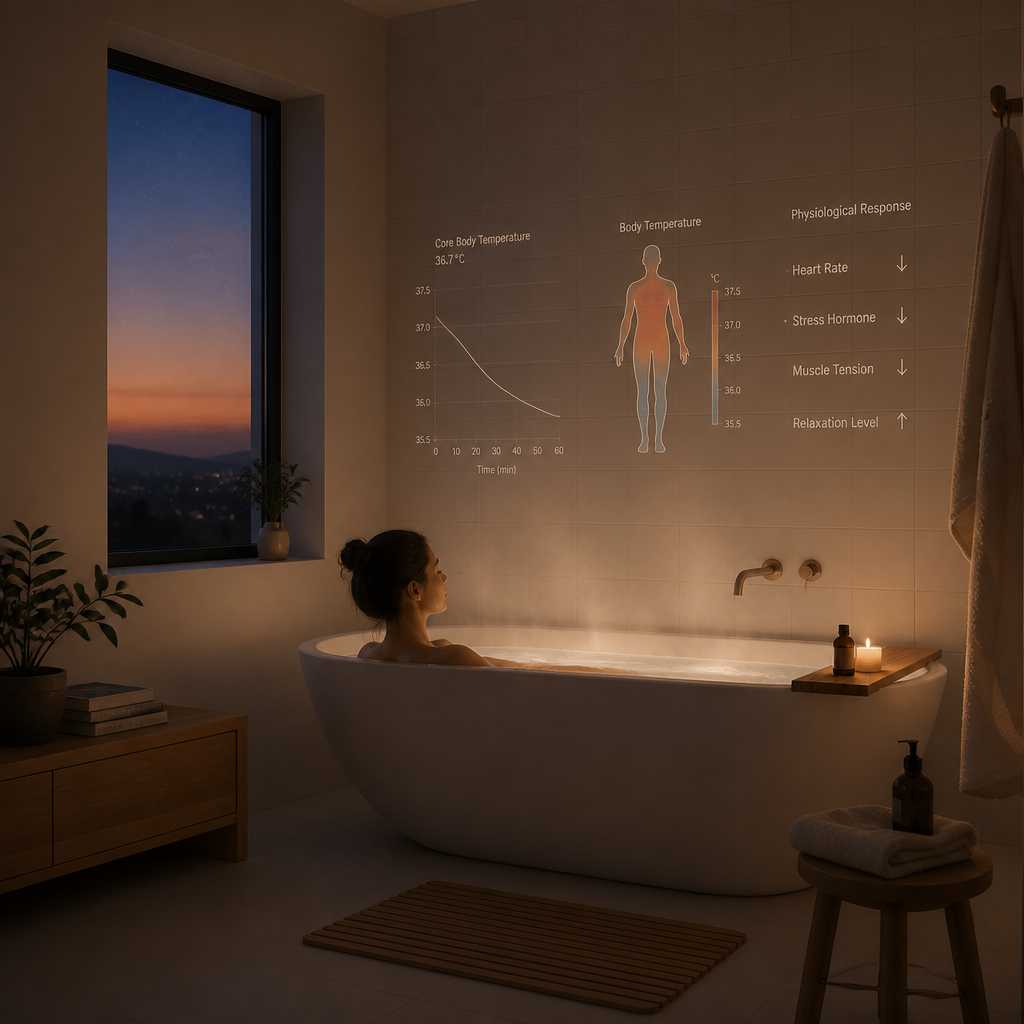
A warm bath accelerates this process by exploiting a vascular reflex called vasodilation. When you submerge in warm water, blood vessels near the skin surface dilate to release excess heat. This is the redness you see on your skin during and after a soak. When you step out of the bath, that heat dissipates rapidly into the cooler air, pulling core temperature down faster than it would fall on its own.
The result is a sharper, faster temperature descent in the exact window that your brain is already primed to respond to. You are essentially amplifying a signal your body was already trying to send.
"Passive body heating by bathing in warm water significantly accelerates the decline in core body temperature, an effect that is associated with shortened sleep onset latency and improved sleep quality." - Haghayegh et al., Sleep Medicine Reviews, 2019
This is why a warm bath outperforms most sleep supplements for physically healthy adults. Melatonin supplements work by introducing an external hormone signal. A warm bath works by optimizing a signal your body generates naturally. It's also solving a different problem than a weighted blanket or white noise machine — we compare all three directly in weighted blanket vs. warm bath vs. white noise. And if muscle-level heat rather than sleep is actually the goal, that's a different tool again — see sauna blanket vs. warm bath.
Why a Shower Does Not Produce the Same Effect
Showers do increase skin temperature, but the contact time and immersion are not sufficient to trigger the same degree of vasodilation. A shower also does not create the sustained thermal environment needed for blood vessels to fully dilate across a broad skin surface area. The data is clear: immersion-based bathing produces consistently stronger sleep outcomes than shower-based protocols in direct comparisons. We compare the two head-to-head, including when a shower is still the smarter choice, in shower vs. bath: which one actually helps you unwind.
In practice, if a bath is not accessible, a warm foot soak in a basin of 40-degree water for 20 minutes produces a partial but meaningful effect. This is because the feet and hands have a disproportionately high density of blood vessels relative to their size, making them highly effective at releasing body heat.
Pro tip: If you travel frequently and cannot access a bath, keep a collapsible foot soak basin in your bag. A 20-minute warm foot soak at the right temperature still produces a measurable drop in core temperature and measurably improves sleep onset latency compared to no thermal intervention at all.
The Optimal Bath Window: Timing Is Everything
The 60 to 90 minute window is not arbitrary. It takes your body roughly that long to complete the vasodilation-and-cooling cycle after exiting a warm bath. By the time you have dried off, settled into your pre-sleep routine, and are lying down, your core temperature will have descended to the point where sleep onset is most likely to occur naturally.
Bathing immediately before bed is a common mistake. It feels counterintuitive because the bath itself is relaxing, but a bath taken within 30 minutes of your intended sleep time can leave your core temperature still elevated when your head hits the pillow. That elevation, even a fraction of a degree, is enough to delay sleep by 30 minutes or more.
How to Find Your Personal Window
Most people sleep between 10 p.m. and midnight. That means a bath at 8:30 to 9:00 p.m. is the practical target for the majority of adults. If your sleep time varies significantly, count backward from your actual target sleep time by 75 minutes. That is your bath start time.
The data consistently shows that the 60 to 90 minute window works across age groups, including older adults who tend to have more disrupted thermoregulation. Elderly participants in sleep studies actually showed larger improvements in sleep quality from warm bathing protocols than younger participants, likely because their natural temperature regulation is less efficient without a thermal assist.
Pro tip: Set a phone reminder labeled "bath time" 75 minutes before your target sleep time for two weeks straight. The consistency of the cue itself will begin to trigger pre-sleep drowsiness even before you enter the water, because your brain learns to associate the reminder with the upcoming thermal drop.
All of this guidance is specifically about the pre-sleep window. If you're also weighing whether a bath makes more sense in the morning on some days, we compare the two directly in morning bath vs. evening bath. And if it's winter and the room itself is working against you, our winter bath ritual guide covers what changes seasonally.
Warm Bath Benefits Beyond Sleep
Sleep is the headline benefit, but the warm bath benefits extend across several systems that feed directly into sleep quality over time. Understanding these secondary effects matters because it explains why a nightly bath ritual compounds in value in ways a single-use sleep aid does not.
Cortisol Reduction
Cortisol, your primary stress hormone, operates on a daily rhythm that should peak in the morning and taper through the day. Chronic evening stress, blue light exposure, and irregular schedules disrupt this pattern, leaving cortisol elevated at night when it should be low. Warm water immersion activates the parasympathetic nervous system, the branch of your autonomic nervous system responsible for rest and digestion, and directly suppresses cortisol output.
This is not speculative. A study published in the journal Evidence-Based Complementary and Alternative Medicine found measurable reductions in salivary cortisol levels following hot water immersion at temperatures comparable to a warm bath. Lower evening cortisol means your brain receives a clearer chemical signal that the day is over.
Muscle Tension and Pain Relief
Heat application to muscles increases local blood flow and reduces the firing rate of pain-signaling nerve fibers. For people whose sleep is disrupted by physical discomfort, particularly lower back tension or chronic muscle fatigue, the warm bath addresses the problem at its source rather than masking it. A bath is not a substitute for medical care when pain is severe, but for everyday tension that accumulates through desk work and physical activity, it is one of the most evidence-supported interventions available without a prescription.
Skin Hydration When Done Correctly
A common misconception is that bathing dries out the skin. The opposite is true when you apply a moisturizer or body oil within three minutes of exiting the bath, while pores are still open and the skin surface is slightly damp. Ingredients like shea butter and squalane absorb more efficiently during this window, leaving skin genuinely hydrated rather than just surface-coated. Which product actually belongs in that window depends on your skin — we compare oil, lotion, and body butter directly in bath oil vs. body lotion vs. body butter. At Bathwater and Beyond, products in the bath essentials range are selected with this post-bath absorption window in mind, which is why bath oils and moisture-locking body butters appear together in curated drops.
How Temperature Choices Compare
Not all baths are equal. Water temperature is the variable that most directly determines whether your bath is working with your sleep biology or against it. The table below compares the three most common approaches.
| Bath Temperature | Effect on Sleep Biology | Best Use Case |
|---|---|---|
| Cool or cold (below 30°C) | Triggers mild sympathetic nervous system arousal. Core temperature does not drop meaningfully post-bath. May increase alertness temporarily. | Morning use, post-workout recovery when alertness is the goal. Not suitable for a pre-sleep protocol. |
| Warm (40 to 42.5°C) | Triggers strong vasodilation, accelerates post-bath core temperature drop, activates parasympathetic nervous system. Directly supports melatonin release and sleep onset. | 60 to 90 minutes before target sleep time. The evidence-backed sweet spot for bath before bed sleep benefit. |
| Hot (above 43°C) | Can cause skin irritation, elevated heart rate, and prolonged core temperature elevation that overshoots the benefit window. Risk of dehydration with extended soaks. | Therapeutic use for specific musculoskeletal conditions under guidance. Not optimal for routine pre-sleep bathing. |
The data on this is unambiguous. The 40 to 42.5 degree Celsius range is not a comfort preference. It is the thermally active window where the vasodilatory response is maximized without triggering the counterproductive effects of extreme heat exposure.
Building Your Evening Ritual Around the Bath
Self-care for better sleep is a phrase that gets used loosely, but the bath-centered evening ritual is one of the few self-care formats with direct mechanistic support in sleep science. The challenge is designing a ritual that is sustainable enough to repeat nightly, because consistency is what allows the circadian training effect to build.
The Three-Phase Approach That Works
Phase one is preparation, which takes about five minutes. Dim the lights in your bathroom, draw the bath to temperature, and add any bath products you are using, whether that is Epsom salts for magnesium absorption, a bath oil for skin benefit, or a sleep-focused mineral soak formulated with calming botanicals. The act of preparation itself begins signaling the nervous system that the evening wind-down has started.
Phase two is the soak, which should run between 10 and 20 minutes. You do not need longer than 20 minutes to achieve the thermoregulatory effect. Extended soaks beyond that do not meaningfully increase the benefit and can cause mild dehydration if you are not hydrating before you enter. Keep a glass of water nearby.
Phase three is the post-bath wind-down. This is where most people leave value on the table. The 30 to 45 minutes after your bath, while your core temperature is actively falling, is your highest-quality pre-sleep window. Engaging with bright screens, stressful content, or high-stimulation activity during this window works against the thermal signal your bath just generated. Instead, apply your body moisturizer, wear a comfortable robe, and do something genuinely low-stimulation: reading on paper, gentle stretching, or simply sitting quietly.
At Bathwater and Beyond, the curated monthly drops are built around exactly this three-phase structure, products selected to support each phase of the ritual without adding unnecessary complexity. A bath soak, a post-bath body oil, and a robe comfortable enough to wear during the wind-down phase are more useful together than any of them are alone.
Common Mistakes That Undercut the Science
The science is solid. The execution is where people lose the benefit. A common mistake is treating the bath as the end of the evening rather than the beginning of the sleep preparation process. People will take a bath, feel relaxed, then spend 45 minutes on social media before bed, fully neutralizing the thermoregulatory advantage they just created.
Another consistent error is water temperature. Most people underestimate how hot 40 degrees Celsius actually feels. If you have only a rough sense of your bath temperature, you may be bathing at 37 or 38 degrees, which is closer to body temperature and produces a much weaker vasodilatory response. An inexpensive bath thermometer eliminates this variable entirely.
A third mistake is skipping the post-bath moisturizing step and then wondering why their skin feels dry in the morning. The bath opens your skin to absorption. If you exit and let your skin air-dry without applying anything, you are leaving the hydration benefit unused while the pores close again within a few minutes.
Finally, people underestimate how quickly consistency builds the circadian association. Three nights in a row is not enough to feel the full compounded benefit. Sleep researchers generally look at two to three weeks of consistent nightly practice before the body's learned association between the bath ritual and sleep onset becomes self-reinforcing.
Frequently Asked Questions
Does a bath before bed actually help you sleep, or is it just relaxation?
It is both, but the primary mechanism is physiological, not psychological. The warm bath triggers vasodilation, which accelerates post-bath core body temperature decline. That thermal drop is one of the body's primary cues to initiate sleep onset. The relaxation effect is real and adds to the benefit, but the thermoregulatory mechanism works even in controlled studies where participants do not report feeling subjectively more relaxed.
What is the ideal water temperature for a sleep-promoting bath?
Between 40 and 42.5 degrees Celsius, which is 104 to 108.5 degrees Fahrenheit. This range produces the strongest vasodilatory response without the risks associated with very hot water, including skin irritation, dehydration, and cardiovascular strain. Use a bath thermometer if you want to be precise, particularly in the first few weeks of establishing the habit.
How long should I soak for sleep benefits?
Between 10 and 20 minutes. The 2019 meta-analysis by Haghayegh and colleagues found meaningful sleep onset improvements with soak durations as short as 10 minutes at the correct temperature. There is no evidence that soaking longer than 20 minutes significantly increases the thermoregulatory benefit, and extended soaks at high temperatures carry a mild dehydration risk.
Can adding bath salts or essential oils improve the sleep effect?
Yes, as a complementary benefit. Magnesium-rich bath salts support transdermal magnesium absorption, which helps regulate the nervous system and supports melatonin production. Lavender essential oil has been shown in controlled studies to reduce heart rate and skin conductance, measurable markers of nervous system activation. These additions do not replace the thermal mechanism but they reinforce it in a meaningful way.
Is it safe to take a warm bath every night?
For most healthy adults, yes. Nightly warm baths are safe and become more effective over time as the circadian association strengthens. People with cardiovascular conditions, pregnancy, or certain skin conditions should check with a physician about appropriate water temperature and soak duration. The main practical concern for daily bathers is skin hydration, which is managed by applying a moisturizer within three minutes of exiting the bath.
Why does my bath make me feel awake sometimes instead of sleepy?
Most likely, the water was too hot, the bath was too close to your intended sleep time, or you engaged with stimulating content immediately after. Very hot water above 43 degrees Celsius can cause a stress response rather than a relaxation response. Bathing within 30 minutes of bed leaves your core temperature still elevated when you lie down. And high-stimulation post-bath behavior, including bright screens or anxious thinking, overrides the thermal signal your bath generated. Correcting the timing and temperature usually resolves this within a few nights.
Does a warm bath help with sleep for older adults?
Yes, and research suggests older adults may benefit even more than younger adults. Thermoregulation efficiency declines with age, meaning the natural pre-sleep temperature drop becomes weaker and less reliable. A warm bath effectively supplements this declining mechanism, and several studies have shown older participants experience larger improvements in sleep quality from warm bathing protocols than their younger counterparts.
If you have tried a nightly bath ritual for sleep, we would genuinely like to know what worked and what did not for you, share your experience in the comments below.
We would love your feedback and any insights you would share with others. What perspective would you add?
References
- National Institutes of Health: research on thermoregulation, sleep onset, and body temperature physiology
- Centers for Disease Control and Prevention: sleep health guidelines and evidence-based recommendations for adults
- Sleep Foundation: science-backed guidance on sleep hygiene, sleep onset latency, and circadian biology
- Harvard Health Publishing: clinical perspectives on warm water immersion and its effects on the nervous system and sleep
- Statista: consumer data and global statistics on sleep quality, sleep disorders, and wellness product usage trends