

Dead Sea Salt vs Himalayan vs Epsom: Soak Guide
You have three bags of bath salts on your bathroom shelf and zero clarity on which one to pour in tonight. This is not a trivial question. Dead Sea salt, Himalayan pink salt, and Epsom salt look almost identical once dissolved in your tub, but they are chemically, mineralogically, and functionally different. Use the wrong one for your goal and you either waste the soak or actively irritate skin that needed hydration. This guide cuts through the wellness-aisle noise with specific, honest information so you pick the right salt for the right night, every time.
Table of Contents
- What Actually Makes These Three Salts Different
- Dead Sea Salt: The Skin-First Choice
- Himalayan Pink Salt: The All-Rounder
- Epsom Salt: The Muscle-Recovery Workhorse
- Side-by-Side Comparison: Which Salt Does What
- How to Use Each Salt Correctly
- Who Should Be Cautious With Bath Salts
- Building Your Evening Ritual Around the Right Salt
- Frequently Asked Questions
- References
What Actually Makes These Three Salts Different
Most bath salt marketing leans hard on the words "natural" and "mineral-rich" without explaining what that actually means for your body. The difference starts with composition. Regular ocean water is roughly 85% sodium chloride. The three bath salts covered here each deviate from that profile in meaningful ways.
Dead Sea salt sits at around 12 to 18% sodium chloride. The rest is a dense stack of minerals including magnesium, calcium, potassium, bromine, and sulfur. Himalayan pink salt is predominantly sodium chloride but carries up to 84 trace minerals, with iron being the element responsible for its characteristic pink colour. Epsom salt is not technically a salt at all. It is a pure compound of magnesium sulfate, meaning it contains no sodium chloride whatsoever.
That last point matters more than most guides acknowledge. When people describe all three as "bath salts," they are grouping two true salts with a completely different class of mineral compound. Each one interacts differently with your skin, your muscles, and your nervous system, which is exactly why blanket recommendations fail.
The mineral profile of what you put in your bath determines the outcome of your soak. Choosing a bath salt without knowing its composition is like choosing a supplement without reading the label.
Dead Sea Salt: The Skin-First Choice
The Dead Sea sits between Jordan and Israel at one of the lowest points on Earth. Its water runs at approximately 34.2% salinity, roughly ten times the concentration of ordinary ocean water. The salt harvested from it carries that extraordinary mineral density. Unlike any other bath salt option, Dead Sea salt has been the subject of genuine clinical research, particularly for chronic skin conditions.
What the Research Actually Shows
Studies on psoriasis patients have documented measurable improvement from Dead Sea salt baths, with research showing that Dead Sea salt baths combined with UVB light produced significantly greater improvement in psoriasis severity scores compared to UVB alone. For atopic dermatitis and eczema, the high magnesium content is understood to help strengthen the skin's moisture barrier, while minerals like zinc and sulfur may support calmer, clearer skin. Patients with compromised skin barriers, as in eczema or psoriasis, absorb minerals more readily than those with intact skin, which is part of why the therapeutic effect is most pronounced in these groups.
Research using isotope tracing techniques has confirmed that magnesium, calcium, and bromide are absorbed percutaneously (through the skin) during immersion, with absorption rates influenced by water temperature, immersion duration, and the condition of the skin barrier. This is not marketing copy. It is documented science.
Best Use Cases for Dead Sea Salt
Dead Sea salt is the strongest choice for anyone dealing with dry or reactive skin, flakiness, mild eczema flare-ups, or skin that feels tight after the shower. It is also the most genuinely hydrating of the three options because its mineral profile supports rather than strips the skin barrier. If your primary goal is better skin after the bath, this is your salt.
It also blends exceptionally well with carrier oils and essential oils, which makes it ideal for building a fuller evening ritual. A few drops of lavender oil in a Dead Sea salt soak is not just aesthetically pleasant. The salt helps your skin retain the moisture from the oil rather than losing it when you towel dry.
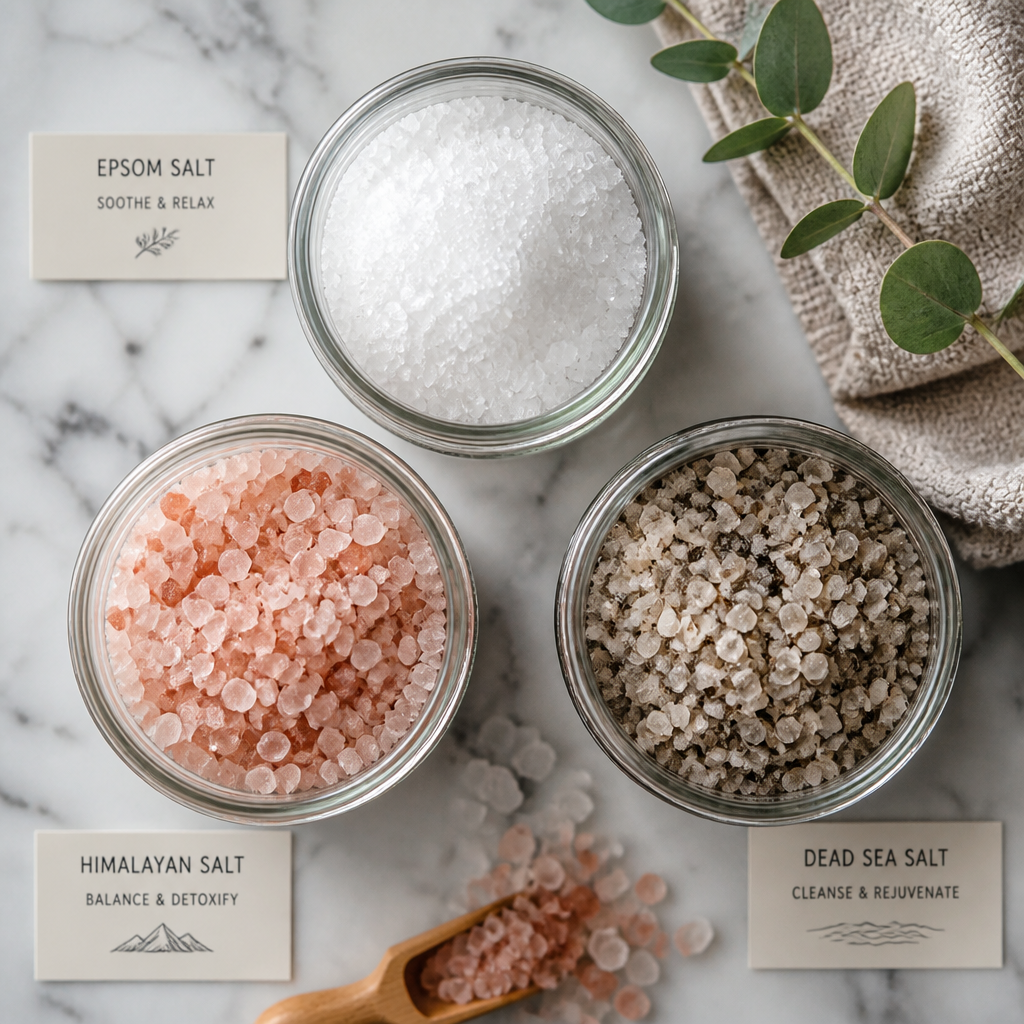
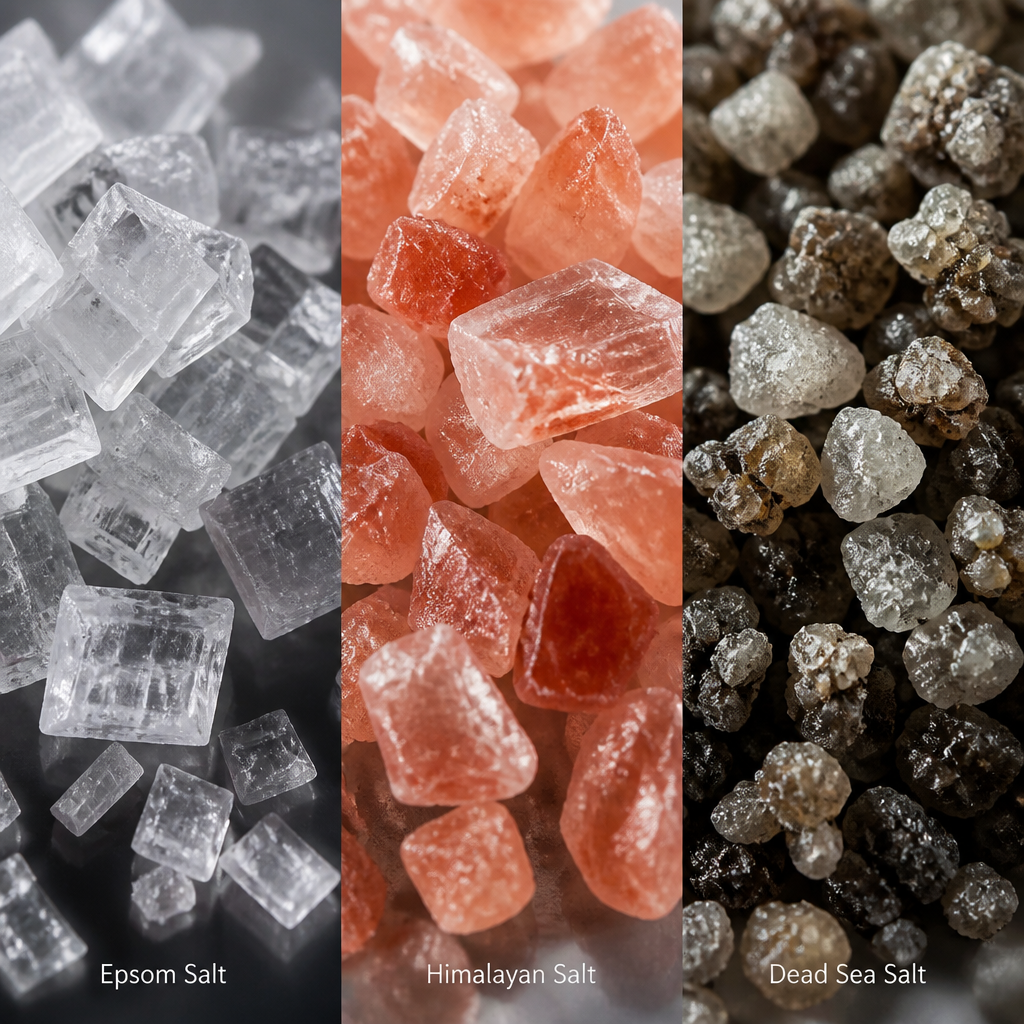
Pro tip: If you have sensitive skin and have never used Dead Sea salt before, start with a smaller amount (around a quarter cup) to test your skin's response. The high mineral concentration is potent and a small number of people experience mild irritation on first use.
Himalayan Pink Salt: The All-Rounder
Himalayan pink salt is mined from the Khewra Salt Mine in the Punjab region of Pakistan, approximately 190 miles from the Himalayan mountain range itself. The deposits formed millions of years ago from the evaporation of ancient inland seas. The salt is hand-extracted and minimally processed, which preserves its natural mineral complexity.
The 84 Minerals Claim, Put in Context
You will see "84 minerals and trace elements" repeated on almost every Himalayan salt product label. The number is widely cited and includes calcium, magnesium, potassium, copper, and iron. The honest context is that while these trace minerals are present, many exist in amounts so small that their individual contribution to a single bath soak is minimal. The cumulative effect of regular Himalayan salt baths is still meaningful, but it is the iron and magnesium content doing the bulk of the work. Iron is what gives the salt its pink colour. Magnesium supports muscle relaxation and skin hydration.
Because Himalayan salt still contains a significant proportion of sodium chloride, it is a gentler choice for skin than Dead Sea salt for people who find high-mineral formulas too intense. It delivers a broader mineral profile than Epsom salt while being less targeted than Dead Sea salt. That balance makes it the most versatile pick for general evening bath use.
When Himalayan Salt Makes the Most Sense
Himalayan pink salt is the right choice when you want a relaxing, skin-softening soak without a specific therapeutic aim. It is also the go-to for gift-giving, partly because the visual appeal of those pale pink crystals reads as intentional and luxurious in a way that white Epsom salt granules simply do not. For anyone building an evening routine from scratch, a Himalayan salt soak three or four nights a week creates a reliable, low-effort ritual that reliably delivers calm and soft skin without being fussy about dosage or timing.
The anti-inflammatory and antibacterial properties of Himalayan salt also make it a reasonable choice for minor skin irritation, though the evidence base here is softer than what exists for Dead Sea salt.
Epsom Salt: The Muscle-Recovery Workhorse
Epsom salt takes its name from a saline spring in Epsom, Surrey, England, where it was first distilled from the local water. It is a pure mineral compound of magnesium sulfate, which means it contains no sodium chloride and behaves quite differently from the other two options once dissolved in water.
What Magnesium Sulfate Actually Does
The primary mechanism is magnesium absorption through the skin. A study conducted at the School of Biosciences at the University of Birmingham tested 19 subjects who took baths at warm temperatures for 12 minutes. Analysis confirmed that both magnesium and sulfate levels had increased in subjects after bathing, supporting the case for transdermal mineral absorption. Magnesium is involved in hundreds of biochemical processes in the body, including muscle function, stress regulation, and sleep quality. Most adults are chronically deficient in it.
For muscle soreness, post-exercise recovery, and general tension in the shoulders and lower back, Epsom salt has the most direct mechanism of the three options. If you have spent a day on your feet, pushed through a hard workout, or are carrying stress-related muscle tightness, an Epsom salt bath is the most targeted response. The sulfate component is also understood to support detoxification pathways, helping the body flush metabolic waste more efficiently.
The Drying Effect: A Real Consideration
Epsom salt's main downside is that it can dry out the skin, particularly with frequent or extended use. Unlike Dead Sea salt, which contains minerals that actively support the skin barrier, magnesium sulfate draws fluid out of cells during the soak. This is part of what makes it effective for puffy, inflamed muscles. It is also why following an Epsom salt bath with a good body oil or moisturiser is not optional, it is part of using the product correctly. People with very dry or eczema-prone skin should either opt for Dead Sea salt instead or follow every Epsom salt soak with thorough moisturisation.
Pro tip: To get the most out of an Epsom salt bath for muscle recovery, aim for a water temperature between 100 and 104 degrees Fahrenheit (38 to 40 degrees Celsius). Warm water increases skin permeability and circulation, which supports mineral absorption. Water that is too hot can strip the skin's natural moisture barrier and undermine the benefit of the soak itself.
Side-by-Side Comparison: Which Salt Does What
Here is a direct comparison of all three bath salts across the dimensions that actually matter when you are standing in front of the shelf deciding what to grab.
| Feature | Dead Sea Salt | Himalayan Pink Salt | Epsom Salt |
|---|---|---|---|
| Primary composition | 12-18% sodium chloride, high magnesium, potassium, calcium, bromine, sulfur | Predominantly sodium chloride with up to 84 trace minerals including iron, magnesium | Pure magnesium sulfate. No sodium chloride |
| Source | Dead Sea (between Jordan and Israel) | Khewra Salt Mine, Punjab region of Pakistan | Originally Epsom, Surrey, England. Now commercially produced |
| Best for | Skin conditions, hydration, moisture barrier support | General relaxation, versatile everyday soak, gifts | Muscle recovery, post-exercise soreness, tension relief |
| Effect on skin | Hydrating, barrier-strengthening, therapeutic for dry or reactive skin | Softening, gently exfoliating, broadly nourishing | Can be drying. Requires moisturising after the soak |
| Clinical evidence | Strongest: studied for psoriasis, eczema, atopic dermatitis | Moderate: anti-inflammatory and mineral-delivery claims, thinner research base | Good: magnesium absorption confirmed, muscle relaxation well-documented |
| Recommended amount per bath | 1/4 to 1/2 cup to start, up to 1 cup when tolerated | 1/2 to 1 cup, up to 2 cups for a stronger soak | 2 cups per standard bathtub |
| Soak duration | 20 to 30 minutes | 20 to 40 minutes | 15 to 20 minutes |
| Ideal frequency | 2 to 3 times per week | 3 to 4 times per week | 2 to 3 times per week |
How to Use Each Salt Correctly
Most guides stop at "dissolve in warm water." In practice, the details determine whether you get a genuinely restorative soak or just a slightly salty bath. Temperature, order of addition, and what you do after the bath all shape the outcome.
Dead Sea Salt: Protocol for Skin Results
Fill the tub with warm water first, then add the salt and stir or swirl with your hand until it fully dissolves before getting in. Starting with a quarter cup and working up to half a cup over a few sessions is the sensible approach for anyone with sensitive or reactive skin. Soak for 20 to 30 minutes. After towelling dry, apply a body oil or rich moisturiser immediately while your skin is still slightly damp. The minerals you have just delivered to your skin barrier will work harder to retain moisture if you lock them in with a hydrating product.
Himalayan Salt: Protocol for Routine and Ritual
Add half to one cup of Himalayan salt to running water and allow the movement of the tap to help dissolve the crystals. For a stronger soak, up to two cups is appropriate for a standard-sized bathtub. Coarse Himalayan salt crystals can take longer to fully dissolve than the finer varieties, so adding them while the tub is filling gives them the best chance. Soak for 20 to 40 minutes. Himalayan salt pairs well with essential oils. Adding them to a small amount of carrier oil before mixing into the bath ensures even distribution rather than floating drops of oil on the surface.
Epsom Salt: Protocol for Muscle Relief
Use two cups of Epsom salt dissolved under warm running water for a standard bathtub. Soak for 15 to 20 minutes, not longer. Longer soaks increase the drying effect without meaningfully increasing mineral absorption. Most people tolerate Epsom salt baths two to three times per week without issue. Daily soaks over extended periods can dry out the skin and are not necessary for the benefits to accumulate. Always follow an Epsom salt soak with moisturiser. This is non-negotiable if you want to avoid irritated, tight skin the next morning.
Who Should Be Cautious With Bath Salts
Bath salts are safe for the overwhelming majority of healthy adults. There are, however, specific conditions where caution is warranted, and the risks differ by salt type.
Epsom salt carries the most significant medical caveat. People with chronic kidney disease face a real risk of magnesium accumulating to dangerous levels in the blood because impaired kidneys cannot efficiently clear excess magnesium. Transdermal absorption during a bath is lower than oral supplementation, but for those with reduced kidney function the risk is not zero. Anyone with kidney disease should speak to their doctor before regular Epsom salt baths.
Dead Sea salt baths are generally well-tolerated and have been studied in clinical populations. A small number of patients in studies experienced skin irritation or thermal reactions, which is why starting with a lower concentration makes sense. People with open wounds, severe sunburn, or actively broken skin should avoid any salt bath until the skin has healed. The high mineral concentration will sting and may slow healing rather than help it.
Himalayan salt is the most broadly gentle of the three options and has the fewest contraindications for healthy adults. However, anyone who has an allergy to sulfur compounds should be aware that some Himalayan salt products include added sulfates.
Pro tip: Pregnant people should consult a healthcare provider before using Epsom salt baths regularly. The transdermal magnesium intake, while generally modest, is a variable worth discussing with a midwife or physician during pregnancy.
Building Your Evening Ritual Around the Right Salt
The best bath salt is the one you actually use consistently. The difference between a one-off soak and a genuine evening ritual is usually habit design, not product quality. That said, matching your salt to your evening need makes the ritual feel less like a routine and more like something you genuinely look forward to.
A practical approach for anyone building a self-care routine: designate two or three nights a week as bath nights and decide in advance which salt fits that evening. Sundays after a long week or a workout call for Epsom salt. Mid-week when skin feels dull and dry, reach for Dead Sea salt. Any night when you simply want warmth and calm without a specific physical complaint is a Himalayan salt night.
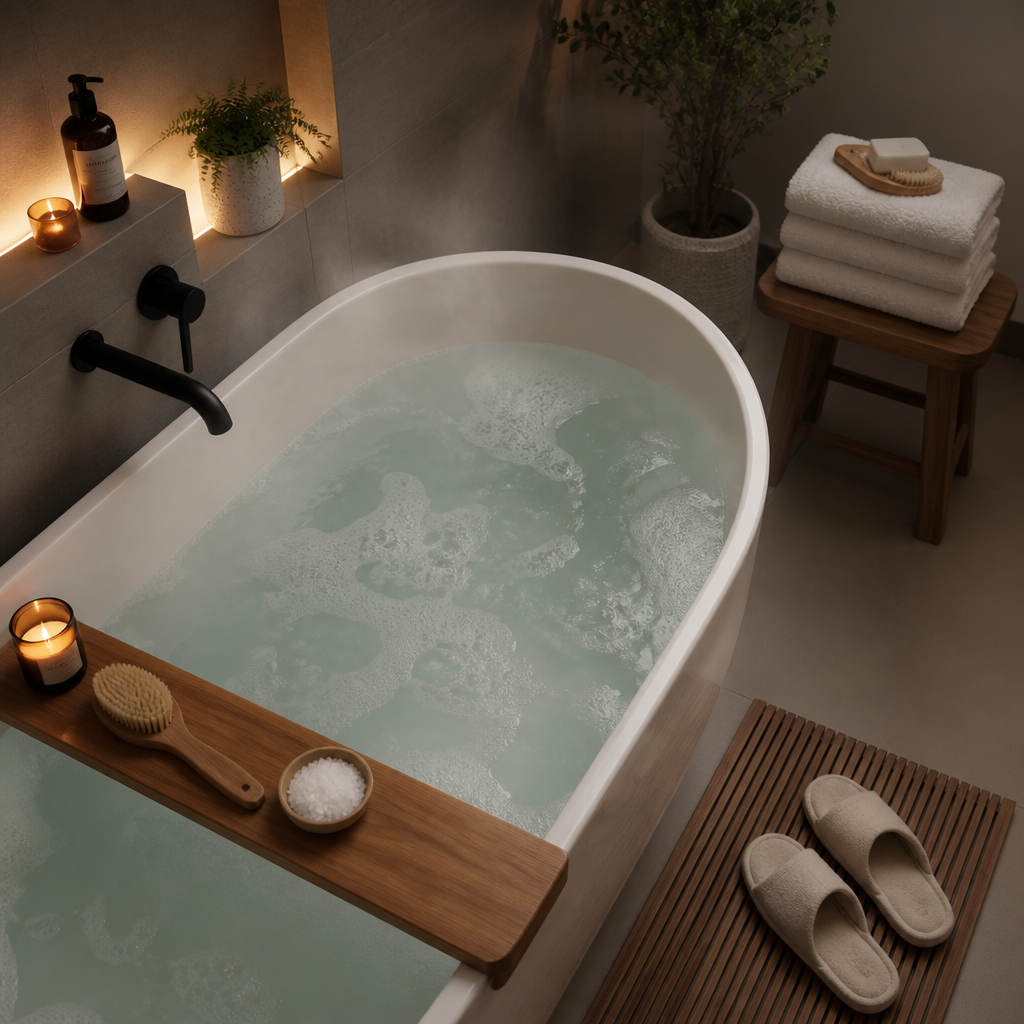
Layering complementary products into the ritual adds depth without complexity. A good quality bath salt pairs well with a fragrance-free body oil applied after the soak, a plush robe worn during the wind-down, and a low-effort scent like a candle lit while the tub fills. These elements are not extravagance for its own sake. They are sensory cues that tell your nervous system that rest is the active task right now. At Bathwater and Beyond, the curated product drops are built around exactly this kind of cohesive, intentional ritual rather than individual product purchases. Browse the current bath essentials collection to find salts, oils, and accessories that work as a complete system.
One more practical note: store your bath salts in a sealed container away from humidity. Epsom salt and Himalayan salt will clump when exposed to moisture repeatedly. Dead Sea salt is hygroscopic (it actively draws moisture from the air) and will turn to a solid block if left open in a humid bathroom. A glass jar with a tight-fitting lid solves this for all three.
Frequently Asked Questions
Can you mix Dead Sea salt with Epsom salt in the same bath?
Yes, and the combination is actually popular for good reason. Dead Sea salt contributes skin-supporting minerals while Epsom salt delivers the muscle-relaxing magnesium sulfate. Use smaller amounts of each rather than full doses of both so the total mineral concentration stays comfortable on your skin. A common starting point is a quarter cup of Dead Sea salt and one cup of Epsom salt per standard bathtub.
Does Epsom salt actually absorb through the skin?
Yes, with caveats. Research from the School of Biosciences at the University of Birmingham confirmed that both magnesium and sulfate levels increased in subjects after bathing in Epsom salt solution. The absorption rate is modest and varies by water temperature, soak duration, and individual skin condition. It is not a high-dose magnesium supplement delivered through the skin. It is a meaningful but limited top-up that complements, rather than replaces, dietary sources of magnesium.
Which bath salt is best for eczema-prone skin?
Dead Sea salt has the most clinical evidence for skin conditions including eczema and atopic dermatitis. Its magnesium content supports the skin moisture barrier and its low sodium chloride concentration means it is far less likely to irritate than regular sea salt. Start with a dilute concentration (a quarter cup in a full tub), soak for 20 minutes, and always moisturise immediately after. If irritation occurs, stop and let the skin heal before trying again.
Is Himalayan salt actually better than regular sea salt for baths?
For bath use specifically, yes, Himalayan salt offers more than regular sea salt. The broader trace mineral profile, even if many individual minerals are present in small amounts, delivers a more complex mineral bath than sodium chloride alone. The texture of coarse Himalayan crystals also makes it effective as a gentle skin exfoliant when applied directly. Regular sea salt is predominantly sodium chloride, which makes it harsher on the skin barrier than any of the three specialist options covered in this guide.
How often should you take a bath salt soak?
Two to three times per week is the practical sweet spot for all three salt types. Daily soaking, particularly with Epsom salt, can dry out the skin over time. For Dead Sea salt used specifically to manage a skin condition, a dermatologist may recommend a different frequency. For general wellness and relaxation with any of the three salts, two to three evenings per week gives you consistent benefits without diminishing returns.
Can bath salts replace professional skin treatments?
No, and that framing sets unrealistic expectations. Bath salts are a genuinely useful part of a self-care routine and have documented benefits for skin hydration, muscle relaxation, and stress relief. They are not a replacement for dermatological treatment of serious skin conditions, physiotherapy for significant muscle injuries, or medical care for chronic conditions. They work best as a consistent, preventative ritual that keeps skin healthy and the nervous system calmer on an ongoing basis.
Why does my Dead Sea salt bath leave a film on the tub?
The high mineral content of Dead Sea salt, particularly calcium and magnesium compounds, can leave mineral deposits on the tub surface after draining. This is normal and not a sign of poor product quality. Rinsing the tub promptly after draining, before the minerals dry and harden, makes it straightforward to clean. A basic white vinegar solution effectively dissolves mineral deposits if they do build up.
Have you tried any of these three bath salts as part of your evening routine? We would love to know which one works best for you and what you pair it with.
References
- Bath salt composition and skin benefits: Himalayan, Epsom, and Dead Sea salts compared
- Mineral absorption research and therapeutic effects of Dead Sea bathing
- Himalayan pink salt origins, mineral profile, and health claims reviewed
- University of Birmingham study on magnesium sulfate absorption through skin during bathing
- Epsom salt bath dosage, frequency, and safety guidelines